Apna Khet Apna Rozgar Scheme Apply Online
Chief Minister Maryam Nawaz Sharif launched Punjab’s revolutionary Apna Khet Apna Rozgar Scheme offering 3-5 acres free agricultural land to landless farmers and rural youth. This program distributes 250,000 acres across 36 districts, benefiting 50,000 families. Participants receive CM Punjab Kisan Card for interest-free financing, Green Tractor subsidies up to Rs 1 million, professional training, machinery access, and market support.
Eligible applicants aged 18-35 with Punjab domicile can apply online at agripunjab.gov.pk or district agriculture offices. The scheme combines land ownership with financial support and technical training, transforming landless laborers into self-reliant farmers and creating sustainable economic prosperity across Punjab.
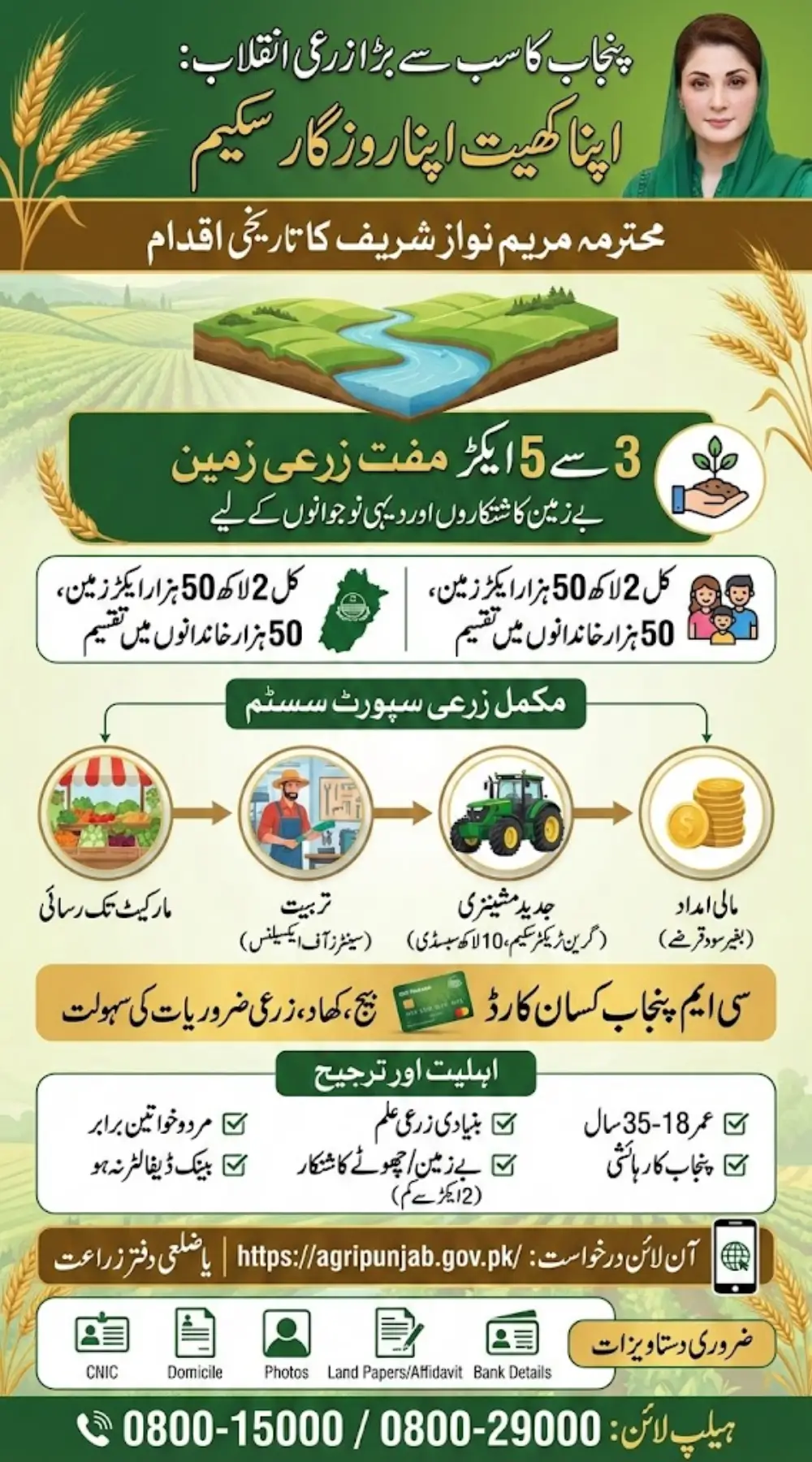
Quick Information: Apna Khet Apna Rozgar at a Glance
| Program Feature | Details |
|---|---|
| Scheme Name | Apna Khet, Apna Rozgar (اپنا کھیت اپنا روزگار) |
| Launched By | Chief Minister Maryam Nawaz Sharif, Punjab Government |
| Managing Department | Punjab Agriculture Department |
| Land Allocation | 3 to 5 Acres per Beneficiary |
| Total Land Available | 250,000 Acres (Approximately 50,000 families) |
| Land Cost | Absolutely Free / Conditional Long-term Allotment |
| Target Beneficiaries | Landless Farmers, Rural Youth (18-35 years), Small Farmers |
| Financial Support | CM Punjab Kisan Card + Interest-Free Loans |
| Machinery Support | Green Tractor Scheme (Up to Rs 1 Million Subsidy) |
| Coverage Area | All 36 Districts of Punjab (Priority: South Punjab) |
| Application Method | Online Portal + District Agriculture Offices |
| Official Website | https://agripunjab.gov.pk/ |
| Helpline Numbers | 0800-15000 / 0800-29000 |
| Year of Launch | 2026 |
What Exactly is Apna Khet Apna Rozgar Scheme 2026?
Let’s be clear—this isn’t a loan program. This isn’t a temporary subsidy. This is genuine land ownership opportunity backed by complete agricultural infrastructure.
The Apna Khet Apna Rozgar scheme represents Chief Minister Maryam Nawaz Sharif’s vision to eliminate rural poverty through agricultural empowerment. Announced during an official visit to Rajanpur, this program commits the Punjab government to distributing 250,000 acres of state-owned agricultural land to deserving, landless citizens across all districts of Punjab.
But here’s what makes this scheme revolutionary: you don’t just get land and good wishes. The government provides everything you need to become a successful farmer—from quality seeds to modern tractors, from expert training to market access. It’s a complete transformation package.
Why is this scheme different from previous programs? Because it addresses the core problem that has kept rural families trapped in poverty for generations—lack of productive assets. When you own land and have the tools to cultivate it properly, you’re not just earning income; you’re building generational wealth.
The Reality Behind Punjab’s Agricultural Crisis (And Why This Scheme Matters Now)
Walk through any village in Punjab today and you’ll see the same story repeating. Young men with agricultural degrees working as labourers. Families managing someone else’s land on exploitative contracts. Educated youth migrating to cities for low-wage jobs because farming without land ownership offers no future.
The numbers tell a harsh story:
- Over 60% of rural Punjab households are either landless or own less than 2 acres
- Youth unemployment in agricultural districts has crossed 25% in some areas
- Rising input costs have made traditional sharecropping economically unviable
- Thousands of acres of government land remain unused while families struggle
CM Maryam Nawaz Sharif recognized this disconnect. Why should productive government land sit idle when hardworking Punjabis are desperate for economic opportunities? Why should agricultural expertise go to waste when Pakistan needs to boost food production?
The Apna Khet Apna Rozgar scheme is the answer. It’s not charity—it’s smart economic policy that benefits everyone. Farmers get sustainable livelihoods. Punjab gets increased agricultural output. Rural communities get stability and prosperity.
Complete Benefits Package: Everything You’ll Receive Under This Scheme
When we say “complete support,” we mean it. Here’s exactly what beneficiaries of the Apna Khet Apna Rozgar program will receive:
1. Free Agricultural Land Allotment
- Land Size: Between 3 to 5 acres of cultivable land (exact size depends on district availability and family needs)
- Land Quality: Productive agricultural land, not barren or unusable plots
- Location: Preference given for land near your current residence or ancestral village
- Ownership Type: Long-term conditional allotment with potential for permanent ownership based on cultivation performance
- Usage Rights: Complete cultivation rights, crop selection freedom, and harvest ownership
2. CM Punjab Kisan Card Financial Support
The Kisan Card isn’t just a plastic card—it’s your financial lifeline for successful farming:
- Direct access to agricultural credit without middlemen or commission agents
- Seasonal credit facility for purchasing seeds, fertilizers, and pesticides
- Government-backed subsidies credited directly to your account
- No interest charges on crop inputs purchased through the card
- Emergency support during natural disasters like floods or droughts
- Already successfully used by hundreds of thousands of Punjab farmers
3. Interest-Free Machinery and Tractor Loans
Modern farming requires modern equipment. The Green Tractor Scheme connected with Apna Khet Apna Rozgar provides:
- Tractor Subsidy: Up to Rs 1,000,000 subsidy on new tractors (50-65 HP models)
- Zero Interest: Completely interest-free financing for land allottees
- Equipment Support: Subsidies for laser land levelers, seeders, and harvesting equipment
- Repayment Terms: Flexible payment schedules aligned with harvest seasons
- Shared Machinery: Access to government-owned machinery for those who don’t need individual tractors
4. Professional Agricultural Training and Technical Support
Land without knowledge produces nothing. That’s why the scheme includes comprehensive training:
- Free enrollment in modern farming technique workshops
- Water-efficient irrigation methods and drip technology training
- Crop rotation planning for soil health and maximum yield
- Pest management and organic farming techniques
- Post-harvest storage and market linkage guidance
- Access to agricultural extension officers for ongoing consultation
- Training conducted through Centres of Excellence established at tehsil level
5. Market Access and Price Support
- Direct connection to government procurement centers
- Minimum support price guarantees for major crops
- Information about market rates through SMS and mobile apps
- Protection from exploitative middlemen and commission agents
- Access to agricultural cooperatives for collective bargaining power
6. Continuous Monitoring and Support System
- Regular field visits by agriculture officers
- Soil testing facilities to optimize crop selection
- Weather forecasting and advisory services
- Help in obtaining crop insurance
- Grievance redressal mechanism through helplines
Who Can Actually Benefit? Complete Eligibility Criteria Explained
The Punjab government has kept eligibility criteria simple but strict to ensure only genuinely deserving candidates receive benefits. Here’s exactly who can apply:
✓ Age Requirement
18 to 35 years old. This scheme targets young people who want to build a future in agriculture. If you’re passionate about farming and within this age bracket, you’re eligible.
✓ Domicile Requirement
Valid Punjab domicile is mandatory. You must be a permanent resident of Punjab province with official domicile certificate. All 36 districts are covered, but priority is being given to South Punjab districts like Rajanpur, Dera Ghazi Khan, Muzaffargarh, and Bahawalnagar.
✓ Land Ownership Status
Preference for landless farmers. If you don’t own any agricultural land, you get priority. However, small landholders (those with less than 2 acres) or people managing land on contract basis may also apply. The idea is to help those who lack sufficient productive assets.
✓ Agricultural Knowledge
Basic farming knowledge required. You don’t need a degree, but you should understand fundamental agricultural practices. This isn’t a program for people who have never touched soil—it’s for those who know farming but lack resources.
✓ Financial Standing
No bank loan defaulters. You must not have any outstanding defaults on previous agricultural loans or government financing. A clear credit history shows you’re responsible with financial assistance.
✓ Gender Inclusion
Both men and women can apply. This scheme is completely gender-inclusive. Women farmers, especially widows or those supporting families, are encouraged to apply and receive equal consideration.
✓ Commitment to Farming
Genuine agricultural interest required. During verification, officials will assess whether you truly intend to cultivate the land or just want to acquire an asset. You’ll need to submit a basic farming plan explaining what crops you intend to grow.
Required Documents: What You Need Before Applying
Don’t wait until registration opens. Start gathering these documents now to avoid last-minute hassles:
Essential Documents (Must Have):
- Computerized CNIC: Valid national identity card with clear photograph
- Punjab Domicile Certificate: Official domicile proving you’re a Punjab resident
- Recent Photographs: Passport-size color photos (usually 4 copies required)
- Mobile Number: Active Pakistani mobile number for SMS updates and verification
- Bank Account Details: Active bank account in your name for subsidy transfers
Land-Related Documents (If Applicable):
- For Landowners: Fard, Intiqal, or Registry documents
- For Contract Farmers: Registered land lease/contract agreement (this requirement may be verified during application)
- For Landless Applicants: Affidavit declaring landless status
Additional Supporting Documents:
- Income certificate (if available)
- Agricultural experience proof (previous crop records, if any)
- Educational certificates (preferably in agriculture, but not mandatory)
Pro Tip: Keep photocopies and scanned versions of all documents ready. The online application will require document uploads, while physical verification may need hard copies.
Step-by-Step Application Process: How to Register for Apna Khet Apna Rozgar
The Punjab government has designed both online and offline application methods to ensure maximum accessibility. Here’s the complete process:
Method 1: Online Application (Recommended)
Step 1: Visit the Official Portal
Go to the Punjab Agriculture Department website at https://agripunjab.gov.pk/ or the dedicated Apna Khet Apna Rozgar portal (URL will be announced when registration opens).
Step 2: Register Your Account
Click on “New Registration” or “Apply for Apna Khet Apna Rozgar” button. Enter your CNIC number and mobile number. You’ll receive an OTP (one-time password) via SMS for verification.
Step 3: Fill the Application Form
Complete all sections carefully:
- Personal information (name, father’s name, date of birth, CNIC)
- Contact details (address, mobile, email if available)
- Domicile information (district, tehsil, village)
- Current land status (landless, small holder, contract farmer)
- Agricultural experience (years of farming, crops grown)
- Banking information (account number, bank name, branch)
Step 4: Upload Required Documents
Scan and upload clear copies of:
- CNIC (front and back)
- Domicile certificate
- Recent photograph
- Land documents or affidavit
- Any supporting certificates
Step 5: Submit Your Farming Plan
Write a simple plan explaining:
- What crops you plan to grow
- Why you chose those crops
- Your expected yield and income
- How you’ll use the land efficiently
Step 6: Review and Submit
Double-check all entered information. Once you click “Submit,” you’ll receive an application reference number. Save this number—you’ll need it to track your application status.
Step 7: Receive SMS Confirmation
Within 24-48 hours, you’ll get an SMS confirming your application has been received and is under review.
Method 2: Offline Application
If you can’t apply online, don’t worry. Visit your nearest District Agriculture Office with all required documents. Agriculture officers will help you:
- Fill the application form manually
- Submit physical copies of documents
- Get a token number for tracking
- Receive updates through SMS or phone calls
Important: Applications submitted through agriculture offices are equally valid as online applications. No preference is given based on application method.
What Happens After Application?
Once you submit, here’s the typical timeline:
- Initial Screening (1-2 weeks): Documents are verified digitally or manually
- Eligibility Assessment (2-3 weeks): Your farming plan and background are reviewed
- Field Verification (3-4 weeks): District agriculture officers may visit your area or call you for interview
- Selection Announcement (4-6 weeks): Successful candidates are notified via SMS and official portal
- Land Allotment (6-8 weeks): You’re informed about your land location and size
- Physical Transfer (8-10 weeks): Official ceremony where land documents are handed over
Note: These timelines are approximate and may vary by district based on application volume and land availability.
Priority Districts and Land Availability Across Punjab
While the scheme covers all 36 districts of Punjab, certain areas are receiving special focus:
High Priority Districts (South Punjab):
- Rajanpur: Where the scheme was officially launched—large government land banks available
- Dera Ghazi Khan: Significant agricultural potential with unemployed youth
- Muzaffargarh: Fertile land near rivers, ideal for diverse crop cultivation
- Bahawalnagar: Cotton and wheat belt with strong farming culture
- Rahim Yar Khan: Extensive state land suitable for modern agriculture
Medium Priority Districts (Central & North Punjab):
- Sahiwal, Okara, Pakpattan (Rice and wheat zones)
- Kasur, Vehari, Khanewal (Mixed cropping areas)
- Jhang, Chiniot, Faisalabad (Cotton and sugarcane regions)
Urban-Adjacent Districts:
- Lahore, Gujranwala, Sialkot, Rawalpindi districts may have limited availability
- Focus is on peri-urban agricultural zones rather than city centers
Key Point: Your chance of selection depends on application volume in your district, available land, and your individual merit—not just the priority ranking.
How Apna Khet Apna Rozgar Will Transform Rural Punjab’s Economy
This isn’t just about giving land to 50,000 families. It’s about triggering a complete rural economic revolution. Here’s the bigger picture:
Immediate Economic Impact:
- Direct Employment: 50,000 families become self-employed farmers overnight
- Indirect Jobs: Thousands more jobs in agricultural supply chains, machinery services, and markets
- Income Generation: Average family earning potential increases from Rs 20,000/month to Rs 50,000+ through land ownership
- Poverty Reduction: Permanent exit from poverty cycle for beneficiary families
Long-Term Agricultural Benefits:
- Increased Production: 250,000 acres of idle land brought under cultivation
- Food Security: More wheat, rice, cotton, and vegetables for local and national markets
- Price Stabilization: Increased supply helps control food inflation
- Export Potential: Surplus production can be exported to earn foreign exchange
Social and Community Impact:
- Youth Retention: Reduces migration to overcrowded cities
- Village Development: More prosperous families mean better schools, health centers, and infrastructure
- Women Empowerment: Female farmers gain economic independence and decision-making power
- Social Stability: Land ownership creates stake in community peace and development
Environmental Benefits:
- Modern farming techniques reduce water waste
- Proper land use prevents soil degradation
- Trained farmers adopt sustainable practices
- Reduced chemical usage through organic farming training
Real Success Stories: What Similar Programs Have Achieved
Punjab has experimented with agricultural support programs before, and the results speak volumes:
Kisan Card Success: Over 400,000 farmers across Punjab are already using Kisan Cards, receiving subsidies worth billions of rupees directly without corruption or delays. Farmers report saving 30-40% on input costs.
Green Tractor Scheme Results: Thousands of young farmers have purchased tractors through subsidized financing, reducing their cultivation costs by 50% and increasing yields by 25-30% through timely operations.
Training Centers Impact: Government-run agricultural training centers have helped farmers adopt tunnel farming, drip irrigation, and high-value crop cultivation, tripling their per-acre income in some cases.
Now imagine combining all these successful elements with actual land ownership—that’s the power of Apna Khet Apna Rozgar.
Common Concerns and Clarifications
Will the land be taken back?
The land is given on long-term conditional allotment. As long as you actively cultivate it and follow agricultural guidelines, it remains yours. The government may even convert it to permanent ownership based on your cultivation record. What you can’t do is sell it, leave it barren, or use it for non-agricultural purposes.
What if I don’t have farming experience?
That’s exactly what the training component addresses. You need basic understanding, but the government will teach you modern techniques, crop management, and market strategies. Think of it as an agricultural apprenticeship with your own land as the classroom.
Can I choose which crops to grow?
Yes, mostly. You have freedom to select crops based on land suitability, market demand, and your expertise. However, agriculture officers will guide you toward crops that work best for your specific land type and climate zone.
Is there really no interest on loans?
Yes, genuinely interest-free financing for land allottees under this scheme. The government absorbs the markup cost. You only repay the principal amount in installments aligned with your harvest seasons.
What about irrigation?
Land allotted will have access to water sources—either canal irrigation, tube wells, or other arrangements. You’ll also be trained in water-efficient methods to minimize costs.
How This Scheme Compares to Previous Government Programs
Pakistan has seen dozens of agricultural schemes over decades. Most failed or had limited impact. What makes Apna Khet Apna Rozgar different?
| Feature | Previous Programs | Apna Khet Apna Rozgar |
|---|---|---|
| Land Ownership | Rare, mostly loans only | Actual land allotment |
| Support Duration | One-time subsidy | Continuous multi-year support |
| Training | Minimal or theoretical | Hands-on, practical, ongoing |
| Machinery Access | Limited, high interest | Interest-free, substantial subsidy |
| Transparency | Political influence, delays | Digital tracking, merit-based |
| Market Linkage | Left to farmers | Government-facilitated access |
This is why agricultural experts are calling Apna Khet Apna Rozgar a “game changer”—it addresses every weakness of previous attempts.
Important Dates and Timeline (Updated 2026)
- Official Announcement: January 2026 (Rajanpur event)
- Application Portal Opening: Expected February-March 2026 (official dates to be announced)
- Application Deadline: Typically 45-60 days from opening (watch for official notifications)
- First Phase Selection: April-May 2026 (anticipated)
- Land Distribution Start: May-June 2026 (in time for Kharif season)
- Full Program Rollout: Throughout 2026 in multiple phases
Critical Advice: Don’t wait for the last day. Apply as soon as the portal opens. Early applications often get processed faster, and you’ll have time to correct any document issues.
Contact Information and Support Channels
Need help, have questions, or want to check application status? Multiple support channels are available:
Agriculture Department Helplines:
- Toll-Free Number 1: 0800-15000
- Toll-Free Number 2: 0800-29000
- Timing: Monday to Friday, 9 AM to 5 PM
- Languages: Urdu, Punjabi, Saraiki
Online Support:
- Official Website: https://agripunjab.gov.pk/
- Email: info@agripunjab.gov.pk
- Expected Response Time: 24-48 hours
Physical Office:
- Head Office: 21-Sir Agha Khan Road, Lahore, Punjab
- District Offices: Agriculture Department offices in all 36 district headquarters
- Visiting Hours: 9 AM to 4 PM (Monday to Thursday), 9 AM to 12 PM (Friday)
Social Media Updates:
- Follow official Punjab Agriculture Department social media accounts for real-time announcements
- SMS updates for registered applicants
Warning: Beware of fraudsters claiming to “guarantee” selection for money. This is a completely merit-based, transparent scheme. No one can guarantee selection through payment. Report suspicious activity to the helpline immediately.
Frequently Asked Questions (FAQs)
Q1: Is there any application fee for Apna Khet Apna Rozgar Scheme?
Answer: No, absolutely zero fees. The application is completely free whether you apply online or through district agriculture offices. Anyone asking for money is a fraudster.
Q2: Can someone who already owns 1-2 acres apply?
Answer: Small landholders may apply, but landless farmers get priority. If you own substantial land (5+ acres), you likely won’t qualify. The scheme is for those who genuinely need productive assets.
Q3: Will women get preference in selection?
Answer: Women are equally eligible and encouraged to apply. While there’s no automatic preference, widows, single mothers, and women supporting families are viewed favorably during merit assessment.
Q4: Can I rent out or sell the allotted land?
Answer: No. The land is for your personal cultivation only. Selling, renting, or leaving it unused violates the scheme conditions and can result in land being taken back.
Q5: What crops are best for maximizing income?
Answer: It depends on your land location, soil type, water availability, and market access. Generally, high-value crops like vegetables, fruits, or tunnel farming earn more than traditional wheat/rice. Agricultural officers will guide you based on your specific situation.
Q6: How long does the verification process take?
Answer: Typically 4-8 weeks from application submission to selection notification. However, this can vary by district based on application volume and land availability.
Q7: What happens if my application is rejected?
Answer: You’ll receive an SMS or email stating the reason for rejection. You may be able to reapply in the next phase if you correct the issues. Common rejection reasons include incomplete documents, ineligibility, or excessive applications versus available land.
Q8: Is the tractor subsidy automatic or do I need to apply separately?
Answer: Land allottees can access the Green Tractor Scheme, but you need to apply separately through the designated process. Being a land allottee gives you priority and better terms.
Q9: Can I apply from abroad if I have Punjab domicile?
Answer: Technically, you can apply online, but you must be present in Pakistan for verification, land transfer, and cultivation. The scheme is designed for those who will personally farm the land, not absentee owners.
Q10: What support is available if crops fail due to weather or pests?
Answer: The government provides crop insurance options, emergency financial support through Kisan Card, and technical assistance for recovery. You won’t be left stranded after one bad season.
Why Apna Khet Apna Rozgar is More Than Just a Land Scheme
Let’s step back and see the bigger picture. For decades, Pakistan’s agricultural policy focused on inputs—subsidizing fertilizer, electricity for tube wells, and loan schemes. These helped, but they never addressed the fundamental inequality: most rural people don’t own land.
When you don’t own land, you have no collateral for loans. You can’t make long-term soil investments. You can’t benefit from land value appreciation. You’re stuck in a cycle where you work hard but never build wealth.
Apna Khet Apna Rozgar breaks that cycle. It’s not welfare—it’s wealth creation. It’s not subsidy—it’s investment in human potential.
Think about what happens when a 25-year-old farmer receives 5 acres:
- Year 1: They learn modern techniques, invest with Kisan Card support, earn decent income
- Year 3: They’ve built expertise, maybe diversified into high-value crops, income doubles
- Year 5: They’re training other farmers, have machinery, contributing to community development
- Year 10: Their children get better education, health improves, they’ve become rural entrepreneurs
- Year 20: Generational poverty has ended. Their family is middle class. Their children have choices their parents never had.
That’s the real promise of this scheme—not just land, but transformation.
Final Words
If you’re reading this and you’re a landless farmer, an unemployed rural youth, or someone struggling to make farming profitable on a tiny plot—this is your moment.
The Apna Khet Apna Rozgar Scheme 2026 isn’t going to come around every year. CM Maryam Nawaz Sharif has put her government’s credibility behind this initiative. The resources are allocated. The land is available. The support system is ready.
What’s needed now is your action.
Start preparing today:
- Gather your documents
- Verify your CNIC and domicile are up to date
- Think about your farming plan
- Talk to your family about commitment to agriculture
- Follow official announcements for application opening
Remember, 250,000 acres sounds like a lot, but divided among millions of potential applicants, competition will be real. The difference between selection and rejection might be how well you prepare and how seriously you take this opportunity.
This website—apnakhetapnarozgar.org.pk—will keep you updated with the latest information, application guides, and success stories. Bookmark it. Share it with fellow farmers. Let’s ensure every deserving person in Punjab knows about this transformative scheme.
Your journey from landless laborer to land-owning farmer starts with a single application. Make it count. Your future and your family’s future may depend on it.
Long live farming. Long live Punjab. Long live Apna Khet Apna Rozgar.
Disclaimer: This article is based on official announcements and publicly available information about the Apna Khet Apna Rozgar Scheme 2026. While every effort has been made to ensure accuracy, applicants should verify details through official channels at https://agripunjab.gov.pk/ or helpline numbers 0800-15000 / 0800-29000. Scheme terms, eligibility criteria, and timelines are subject to official government notifications.